
Denton County City Directory Collections
Denton city directories work best as an overlapping shelf of finding aids, not as one complete annual run. The clearest online volume is a digitized 1936 directory, while an earlier 1923 item provides another entry point. At the library, city and telephone directories sit beside maps, newspapers, yearbooks, genealogy tools, and local histories. That mix helps when a name is absent from one book or an address has changed. Preserve the item, printed page, and access date with every useful result.
| Collection | Years | Where Held | Access |
|---|---|---|---|
| Directory of the City of Denton | 1936 | Portal to Texas History | Digitized page images online |
| Retail Merchants’ Association directory item | 1923 | Portal to Texas History | Online item and page navigation |
| City and telephone directories | 1918 onward noted; broader runs from the 1930s or 1940s | Emily Fowler Central Library | Consult local-history holdings |
| Maps, newspapers, and family-history material | Varies by item | Emily Fowler and County History & Culture | Digital, onsite, or appointment access |
The date statements do not line up perfectly. Denton Public Library’s house guide describes directories as extensive or complete back to the 1940s and limited before that. Its genealogy guide points to city directories in the 1930s and telephone directories from 1918, while a county archive result mentions directories beginning in 1920. Those are useful leads, not a promise that every year survives. Ask staff for the specific volume, and record a missing year as a gap instead of filling it with an assumption.
Denton County’s 1936 Directory
The digitized 1936 Denton directory is a 142-page Retail Merchants’ Association publication supplied by Denton Public Library. Its metadata identifies businesses, residences, and advertisements, which makes it useful for placing a person in the commercial and civic setting of a particular year. Portal to Texas History added the item in 2026 through the Rescuing Texas History collection work. Search results from the OCR are only a starting point. Initials, numbers, and abbreviations should be checked against the scanned page.
The item view supports page-by-page checking, so a citation can retain both the directory item and the printed page rather than relying on a text hit alone.
Denton County Directory Holdings
Emily Fowler Central Library at 502 Oakland Street is the local gateway for Denton genealogy and local history. Its collections include city and telephone directories, maps, school yearbooks, newspapers, photographs, church histories, family histories, and ephemera. The current digital catalog and exhibits live through Emily Fowler Special Collections. The older genealogy guide is still helpful for identifying microfilm and index leads, but its service details should be confirmed before a visit.
Some material is online, yet the municipal archive and some special collections are appointment-limited. The library research contact listed in the guide is genealogy@cityofdenton.com, and the main telephone is 940-349-8752. Provide a surname, street, approximate year, and alternate spelling before asking for a pull. For an onsite request, note the call number, reel, box, item, and page. That small paper trail makes a later comparison far easier.
The Special Collections display includes local digital exhibits and collection material that can help explain a name found in a directory. It does not make every physical item searchable online.
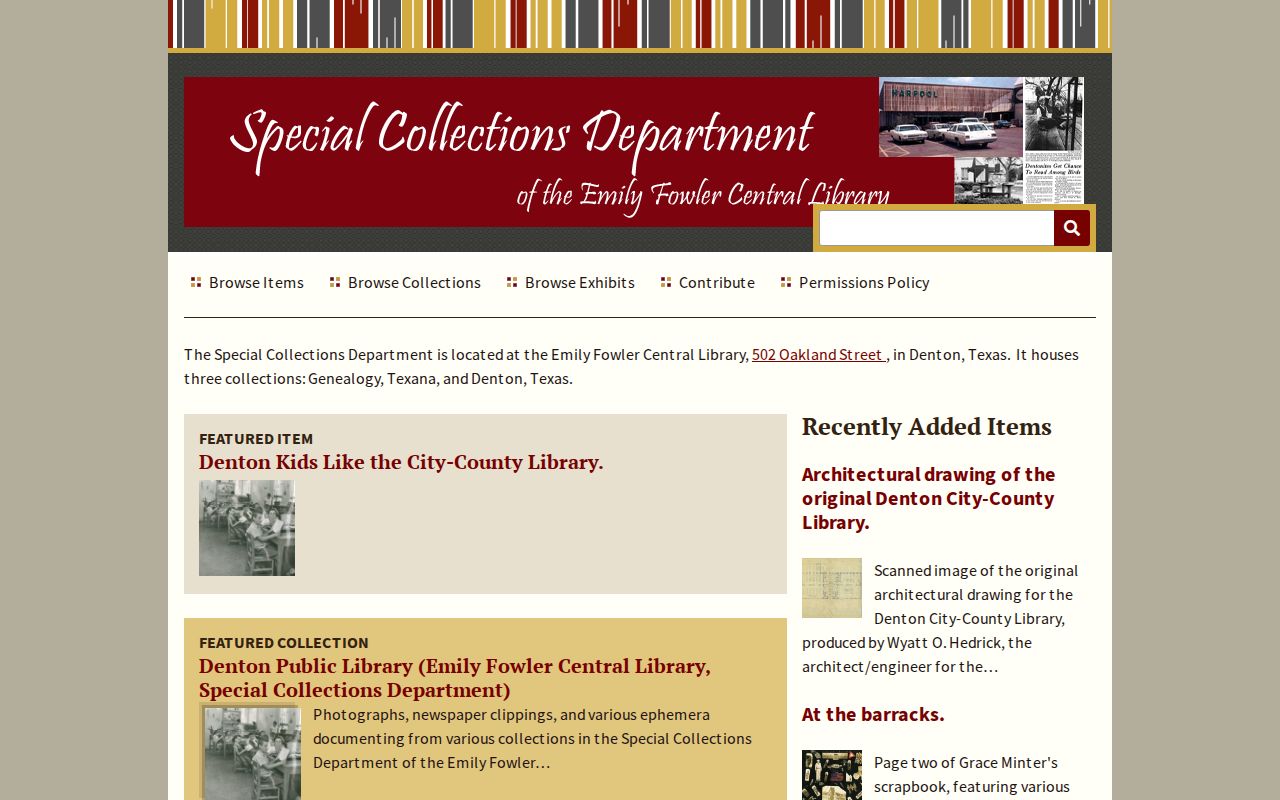
Use the digital collection as a doorway, then confirm whether the cited directory, map, or newspaper issue is online, on microfilm, or available only through staff-assisted access.
Note: Older library guides describe some fees and hours, so current library staff should confirm service details before travel or copy requests.
How Denton County Directory Entries Read
A Denton city directory entry can hold much more than a name. The 1936 sample page pairs names with a spouse or related household name in parentheses, an occupation, an employer or institution, a residence, and sometimes an ownership notation. The page also has a printed key. It says an asterisk means no children under 18, while O or Owr marks an owner. Those marks belong to that publication and year. They should not be turned into current facts or into title proof.
| Printed name | Keep surname, given name, and initials as printed. |
|---|---|
| Household clue | A parenthetical name may identify a spouse or associated household name. |
| Occupation and institution | Record the printed role and employer or school abbreviation without guessing its meaning. |
| Residence | Copy the historic street form exactly before attempting a modern address match. |
| Markers and page | Capture the printed owner or child marker, legend, item URL, and page number. |
The 1936 sample entry page shows why transcription needs care: names, initials, address numbers, and short forms are easy for OCR to distort.
Read the image and the legend together. A residence line establishes a printed association for that directory year, while ownership still needs confirmation from a title source.
- Criss-cross directory
- An address-ordered directory that can place listed names along a street. Confirm that a particular Denton volume actually has this section.
- Householder index
- A name list arranged around a household or address, useful for connecting an individual entry to a residence line.
- Abbreviation key
- The publisher’s legend for short forms and markers. Save it with the entry because the key can change across years.
Denton County City Directory and Quakertown
Denton’s directory material also carries neighborhood history. The Quakertown exhibit draws on the 1920 city directory to identify about 64 mostly Black households in an area of roughly 32 acres bounded by Oakland, Withers, Bell, and McKinney, with Terry, Commercial, and Sanders running through it. The exhibit also notes the Fred Douglass School and local businesses. This is valuable historical context, not a complete census of every household or a statement about present residents.
The Quakertown exhibit, maps, newspapers, and the original scanned directory should be read together. Neighborhood labels can shift over time, and a single name needs independent confirmation through the original directory page, a map, or another dated record. That approach preserves both the history and the limits of the evidence.
Denton County Directory Addresses After 1920
Historic Denton addresses do not always align with a modern number. Library and city history material identifies a February 1920 renumbering, part of an early-1920s grid and paving program. It used 300-foot blocks and 100 numbers per block. There is no universal conversion table in the research, so an old number should never be silently swapped for a current one. Match the street name, nearby landmarks, owner, legal description, and map evidence before deciding that two address forms describe the same place.
A digitized 1912 Denton map can help establish the earlier street layout. It can show setting, street numbering, or a building footprint when the item covers the area, but it does not establish title or a household by itself. Preserve each bridge as documented, probable, or unresolved.
Note: A matching street name is useful evidence, but subdivision, replats, and the 1920 renumbering can make the same number misleading.
Trace Denton County City Directories
Follow a household through Denton city directories one issue at a time. Start with a known spelling, then look at nearby alphabetical entries and the next available year. A disappearing name can reflect a move, death, changed listing practice, or an OCR miss. Federal census resources at library workstations reach 1940, so they work best as dated household snapshots between directory runs. The census is historical evidence, not proof of a present address.
- Find the earliest confirmed name entry and save its item URL and printed page.
- Compare the next available directory, retaining every change in address, initials, household clue, and institution.
- Check an address-ordered section only when that volume provides one, then keep adjacent names separate from family claims.
- Pair a directory period with the nearest available federal census at a library workstation and compare the household facts.
- Use the local obituary index, cemetery material, newspapers, or a recorded instrument to test a move, death, or ownership claim.
The Denton Record-Chronicle provides another time layer. Emily Fowler’s house guide notes microfilm from 1909 to 2018 and a digitization gap around 1981 through 2002, so an online miss is not the end of the search. The Portal’s digital collection can supply earlier papers and the DRC collection, while the library’s microfilm may be the better route for the gap. Compare a notice to its original issue and keep the publication date.
Denton County Directory Research Room
County History & Culture’s Research Room adds an onsite layer for early people and places, cemetery and burial material, family papers, courthouse holdings, and local guides. It is open Monday through Friday from 9 to 4 and Saturday from 11:30 to 2:30. Appointments are recommended, special collections need advance notice, and staff do not pull material during the final half hour. Call 940-349-2850 before making a source-dependent trip.
Denton County’s history also explains why a directory may be more useful than expected. The county was created in 1846, the seat moved to Denton in 1857, and the first courthouse burned in 1875, destroying most early county records. When a pre-fire record is missing, test surviving tax rolls, probate, newspapers, cemetery records, family papers, microfilm, and nearby-county sources. Label the result as surviving substitute evidence, not a complete chain.